
Choosing the Right Orthodontic Treatment: Metal vs. Invisalign vs. Lingual
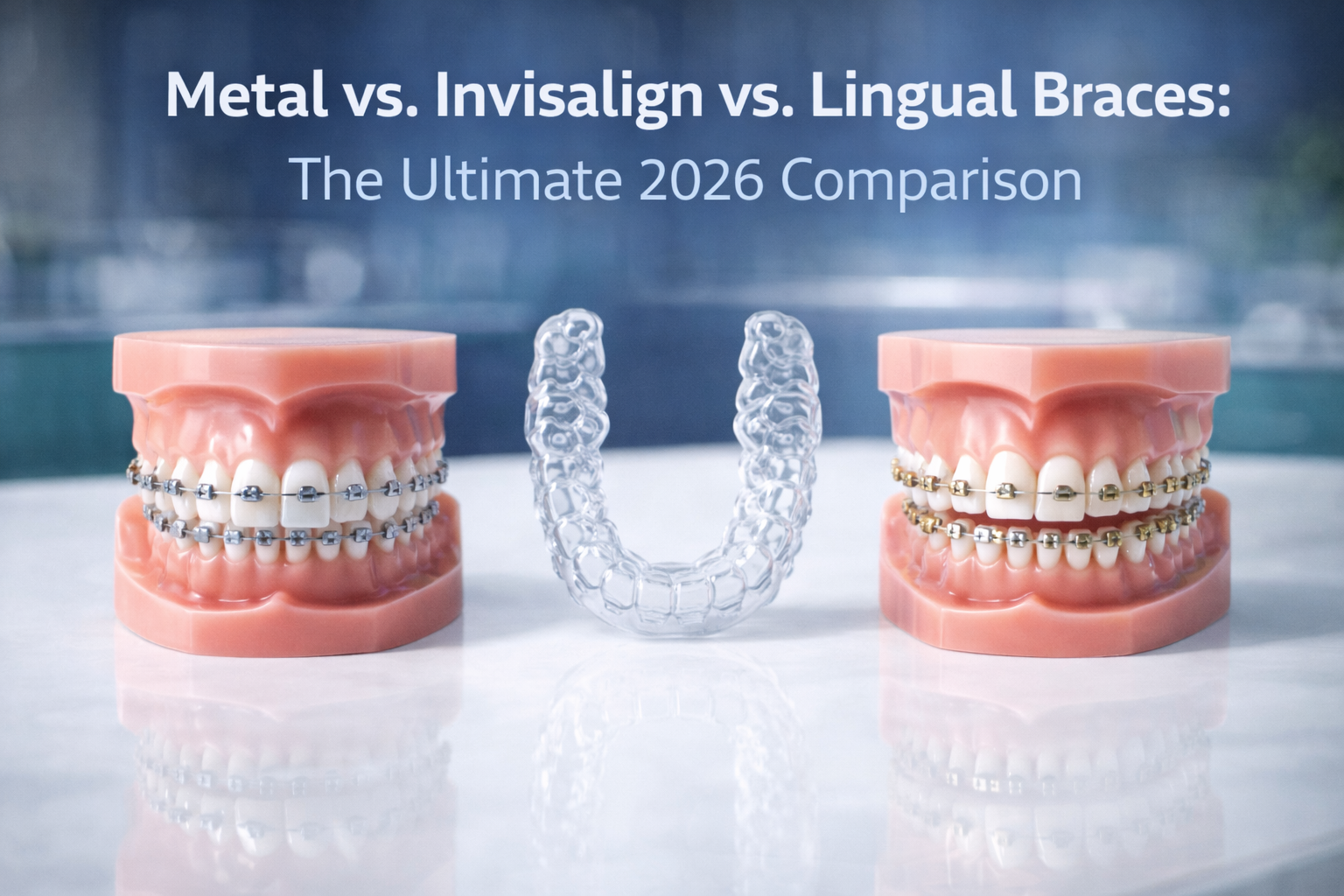
Executive Summary: The Orthodontic Landscape in 2025
The decision to undergo orthodontic treatment in 2025 is no longer a simple choice between metal brackets and a confident smile. It is a complex intersection of clinical biomechanics, financial planning, and lifestyle integration. With the global orthodontic market expanding and technology democratizing access to care, patients are presented with a triad of primary options: traditional metal braces, clear aligner therapy (exemplified by Invisalign), and lingual braces (such as InBrace or Incognito). Each modality represents a distinct approach to the biological imperative of tooth movement, carrying unique implications for the patient’s daily life, bank account, and long-term oral health.
As a Senior Orthodontic Consultant, this report aims to dismantle the marketing narratives surrounding these treatments and provide a rigorously researched, evidence-based analysis. We will explore the “Your Money or Your Life” (YMYL) aspects of orthodontics, adhering to high standards of Expertise, Experience, Authoritativeness, and Trustworthiness (E-E-A-T). This document serves as a comprehensive guide for patients, parents, and professionals navigating the 2025 orthodontic ecosystem, offering detailed cost structures, Medicaid intricacies, biomechanical realities, and the unvarnished truth about life during treatment.
Part I: Clinical Biomechanics and Efficacy
1.1 The Biological Basis of Tooth Movement
Regardless of the appliance used—whether a plastic tray or a titanium wire—the biological principle remains constant: the application of sustained pressure to the crown of the tooth to induce bone remodeling in the alveolar socket. This process involves osteoclasts breaking down bone on the pressure side and osteoblasts rebuilding bone on the tension side. However, the delivery system of this force varies radically between the three main treatment modalities, influencing efficacy, speed, and the types of malocclusions that can be treated.
1.1.1 Fixed Appliance Mechanics (Metal & Lingual)
Fixed braces operate on a “pull” and “torque” mechanics system. The bracket acts as a handle on the tooth, and the archwire acts as a track. By engaging a wire into a bracket slot, the orthodontist gains three-dimensional control over the tooth:
- First Order: In/Out movement and rotation.
- Second Order: Tipping (mesial-distal angulation).
- Third Order: Torque (root inclination).
In 2025, the standard of care involves the use of heat-activated Nickel-Titanium (NiTi) wires. These wires utilize shape-memory technology; when chilled, they are pliable, but at body temperature, they strive to return to their original arch form, exerting a constant, gentle force that is highly efficient for leveling and aligning. This continuous force is particularly superior for extruding teeth (pulling them down), correcting severe rotations, and managing root parallelism in extraction cases.
1.1.2 Clear Aligner Mechanics (Invisalign)
Clear aligners utilize “push” mechanics. The plastic tray must encompass the tooth and push it into the desired position. Because plastic is not as rigid as steel, aligners historically struggled with root control. Modern systems in 2025, such as Invisalign G8/G9, utilize “SmartForce” features—composite attachments bonded to the teeth that act as leverage points.
Despite these advancements, the efficacy of aligners is fundamentally different. A systematic review indicates that while aligners are highly effective for distalization (moving molars back) and expansion, they still lag behind fixed appliances in achieving precise occlusal contacts and controlling severe root torque. The “plastic” limit means that for severe skeletal discrepancies or teeth that need to be rotated more than 45 degrees, the failure of the plastic to “grip” the tooth can lead to “non-tracking,” where the tooth lags behind the aligner projection.
1.2 Comparative Efficacy Studies: The Data
When evaluating “which is better,” we must look at clinical outcomes. Recent randomized controlled trials (RCTs) and systematic reviews from 2024 and 2025 provide a nuanced picture.
| Clinical Parameter | Metal Braces | Invisalign (Clear Aligners) | Lingual Braces |
|---|---|---|---|
| Simple Crowding | Highly Effective | Highly Effective | Highly Effective |
| Severe Rotation (>45°) | Superior Control | Variable/Requires Attachments | Superior Control |
| Deep Bite Correction | Excellent | Good (with bite ramps) | Good |
| Root Torque | Excellent | Moderate/Difficult | Excellent |
| Extraction Space Closure | Excellent (Bodily movement) | Moderate (Risk of tipping) | Excellent |
| PAR Score Reduction | ~80% Reduction | ~75% Reduction | ~80% Reduction |
| Treatment Duration (Avg) | 18-24 Months | 12-18 Months (Mild cases) | 18-24 Months |
1.3 The Lingual Variance: The Invisible Powerhouse
Lingual braces (e.g., Incognito, InBrace) represent a hybrid of efficacy and aesthetics. Because they are fixed, they offer the mechanical advantage of 3D control. However, the biomechanics are more complex because the inter-bracket distance is shorter on the lingual arc, making the wires stiffer and harder to engage. To counter this, modern lingual systems use 100% customized cast-gold or alloy brackets and robotically bent wires. This customization ensures the profile is as low as possible to minimize tongue irritation, but it also means the “lab fee” to the doctor is astronomically higher—a cost passed directly to the patient.
Part II: The Economic Ecosystem of Orthodontics in 2025
Understanding the cost of braces requires peering behind the curtain of the dental practice. The fee a patient pays is not arbitrary; it is derived from a combination of Laboratory Fees, Chair Time, Clinical Expertise, and Overhead. In 2025, inflation and technological costs have pushed the average price of orthodontic treatment into the $3,000–$10,000 range.
2.1 Comprehensive Cost Breakdown by Treatment Type
The following analysis breaks down the financial commitment for the three modalities based on national averages and 2025 fee schedules.
2.1.1 Traditional Metal Braces
$3,000 – $7,000
- Lab Fee: Low (~$200-$400). Brackets are prefabricated.
- Chair Time: High. Manual positioning and wire bending.
- Value Proposition: The most cost-effective option. The “workhorse” of orthodontics.
2.1.2 Invisalign (Clear Aligners)
$3,500 – $8,500
- Lab Fee: High ($1,400 – $1,900 paid to Align Tech).
- Chair Time: Low. Short check-ups.
- Value Proposition: Paying for technology/IP. Doctor’s margin is squeezed by lab fees.
2.1.3 Lingual Braces
$8,000 – $13,000
- Lab Fee: Very High ($1,500 – $3,000+). Custom-cast gold/alloys.
- Chair Time: Very High. Ergonomically difficult.
- Value Proposition: A luxury product. The only truly invisible option without compliance.
2.2 Regional Cost Variability (The “Zip Code” Factor)
The cost of treatment is heavily correlated with the local cost of living and the density of providers.
| Region | Metal Braces Cost | Invisalign Cost | Lingual Braces Cost |
|---|---|---|---|
| NYC / Manhattan | $4,000 – $8,000+ | $4,500 – $9,000 | $10,000 – $13,000+ |
| Texas (Houston/Dallas) | $3,000 – $6,000 | $3,500 – $7,000 | $8,000 – $10,000 |
| Midwest / Rural | $2,750 – $5,500 | $3,250 – $6,000 | Rare / Specialist |
| National Average | $5,000 | $5,500 | $10,000 |
Analysis: In high-rent districts like Manhattan, overhead costs drive prices up significantly. Conversely, in competitive markets like Houston or Dallas, prices may be compressed due to the high volume of providers.
2.3 Hidden Costs and Fees
The “sticker price” rarely covers the entire lifecycle of orthodontic treatment. Patients in 2025 must budget for these often-overlooked expenses:
- Diagnostic Records ($150 – $500): Comprehensive X-rays (Cephalometric and Panoramic), 3D intraoral scans, and photos are required for diagnosis. Some offices bundle this; others bill separately.
- Retainer Replacement ($150 – $1,000): Retention is for life. A set of Vivera (Invisalign brand) retainers can cost up to $1,000 for four sets. A standard Hawley retainer costs $150-$350 to replace. Bonded (permanent) retainers cost $250-$500 per arch.
- Lost Aligners: If a patient loses an Invisalign tray, replacement fees can range from $50 to $100 per tray, or up to $600 for a warranty plan.
- Emergency Visits: Broken brackets (usually after eating forbidden foods) may incur a $25-$50 fee after a certain number of breakages. See our Food Guide to avoid this.
- Extractions/Surgery: If teeth need to be pulled to create space, this is billed by an oral surgeon, not the orthodontist, and can add $200-$600 per tooth.
Part III: Insurance, Medicaid, and Financial Aid
Navigating the insurance landscape is arguably more painful than the treatment itself. The financial assistance available for orthodontics is strictly categorized by age and medical necessity.
3.1 Private Dental Insurance (PPO)
Most dental PPO plans (Delta, Cigna, Aetna, etc.) treat orthodontics as a separate rider with a Lifetime Maximum.
- The 50% Rule: Plans typically cover 50% of the fee, up to the lifetime max.
- The Cap: This maximum is usually $1,000, $1,500, or rarely $2,000-$3,000.
- Example: If braces cost $6,000 and your plan covers 50% up to $1,500:
- • 50% of $6k = $3,000.
- • Plan pays: $1,500 (the cap).
- • You pay: $4,500.
- Age Limits: Many plans only cover orthodontics for dependents up to age 19. Adult orthodontics is frequently an excluded benefit.
3.2 Medicaid and CHIP (State-Funded Care)
For low-income families, Medicaid (and CHIP) is the primary avenue for care. However, Medicaid does not cover cosmetic braces. It is mandated by the EPSDT (Early and Periodic Screening, Diagnostic and Treatment) program to cover “medically necessary” services for children under 21.
3.2.1 Determining “Medical Necessity”: The Indices
States use strict scoring systems to act as gatekeepers. If a child’s malocclusion does not score high enough, coverage is denied.
- HLD Index (Handicapping Labio-Lingual Deviation): Used by states like Arkansas, California, New Jersey, and others. It measures overjet, overbite, mandibular protrusion, and crowding.
- • Arkansas: Requires a score of 28+.
- • New Jersey: Requires a score of 24+.
- • Connecticut: Requires a score of 26+.
- Automatic Qualifiers: Regardless of score, certain conditions usually qualify:
- • Cleft lip/palate.
- • Deep impinging overbite (lower teeth biting into the roof of the mouth causing tissue destruction).
- • Impacted permanent teeth (teeth stuck in the bone).
3.2.2 The “Medicaid Gap” for Adults
Adults (21+) generally have zero coverage for orthodontics under Medicaid, regardless of severity. Exceptions are extremely rare and limited to reconstructive surgery following severe trauma or craniofacial deformities.
3.3 Medicare (Seniors)
Original Medicare (Part A & B) excludes routine dental and orthodontic care. While some Medicare Advantage (Part C) plans offer dental riders, the coverage for orthodontics is minimal to non-existent. Seniors seeking alignment for restorative purposes (e.g., to make space for an implant) must typically pay out-of-pocket or utilize financing like CareCredit.
Part IV: Patient Experience and Lifestyle Implications
Beyond the clinical and financial, the “soft” factors of daily life often drive the final decision.
4.1 Pain and Discomfort Profiles
- Invisalign: Generally reported as less painful. The pain is described as a “pressure” or “soreness” that peaks 24-48 hours after changing to a new tray. There are no wires to poke the cheeks, leading to fewer soft tissue injuries.
- Metal Braces: Discomfort is twofold. First, the “tightening” force can cause significant aching for 3-5 days. Second, the brackets physically abrade the buccal mucosa (inner cheeks), requiring the patient to build up “calluses” over the first few weeks. Read Pain Relief Tips.
- Lingual Braces: These have the highest initial discomfort curve. The tongue is incredibly sensitive and constantly interacts with the brackets during speech and swallowing. Patients often experience tongue lacerations and soreness for 2-4 weeks. Products like “Gishy Goo” or orthodontic wax are essential for survival during this adaptation phase.
4.2 Speech Impediments
- Metal/Ceramic: Minimal impact.
- Invisalign: A slight lisp is common for the first 1-2 days as the tongue adjusts to the plastic thickness.
- Lingual: A significant lisp is almost guaranteed. Because the brackets occupy the space where the tongue contacts the teeth to form sounds like “s”, “t”, and “d”, speech can be “slushy.” Adaptation takes 2-4 weeks of practice.
4.3 Hygiene and White Spot Lesions (WSL)
One of the greatest risks of orthodontics is decalcification—permanent white scars on the teeth caused by plaque accumulation around brackets.
- Metal/Lingual: High risk. Brushing and flossing are mechanically difficult. Floss threaders or water flossers are mandatory. Lingual braces are particularly hard to clean due to poor visibility. See Hygiene Routine.
- Invisalign: Low risk. Because trays are removed for eating and cleaning, patients can maintain their normal hygiene routine. This makes aligners the preferred choice for patients with pre-existing periodontal issues.
Part V: The Digital Frontier (2025 Innovations)
Technology has shifted the orthodontic paradigm from “reactive” to “proactive.”
5.1 Remote Dental Monitoring
In 2025, the “check-up” visit is becoming virtual. Systems like DentalMonitoring utilize AI and a smartphone attachment to scan the teeth weekly.
- How it works: The patient scans their smile using an app. The AI analyzes the fit of the aligner or the integrity of the bracket.
- Benefit: It reduces office visits by up to 50%. If the AI sees the aligner fits well, the patient is cleared to move to the next tray without driving to the office. If a bracket is broken, the office is notified immediately.
- Cost: Most forward-thinking practices bundle this into the treatment fee to improve efficiency.
5.2 3D Printed Brackets (LightForce)
A new category of fixed appliances has emerged: 3D-printed ceramic brackets (e.g., LightForce). Unlike stock metal brackets, these are printed to fit the exact curvature of the patient’s tooth. This reduces bond failure rates and allows for faster treatment, bridging the gap between the customization of lingual braces and the mechanics of buccal braces.
Part VI: Decision Matrix and Conclusion
To synthesize this exhaustive data into a decision, patients should consult the following matrix:
| If your priority is… | The Best Option is… | Because… |
|---|---|---|
| Lowest Cost | Metal Braces | Lowest lab fees and widest provider availability. |
| Maximum Aesthetics | Lingual Braces | Truly invisible; no glare or plastic sheen. |
| Comfort & Hygiene | Invisalign | Removable, less pain, no dietary restrictions. |
| Complex Bite Correction | Metal/Lingual | Superior root torque and biomechanical control. |
| Lifestyle/Discipline | Metal Braces | Fixed appliances work 24/7; zero compliance required. |
| Professional Speaking | Invisalign/Metal | Lingual braces pose a significant risk to speech clarity. |
Conclusion: There is no “best” treatment, only the treatment that best fits the specific malocclusion and lifestyle of the patient. Metal braces remain the reliable, cost-effective engineer of the smile. Invisalign offers a sleek, modern alternative for the disciplined patient. Lingual braces provide the ultimate aesthetic solution for those with the budget to support it. In the era of YMYL, the best investment is a consultation with a board-certified orthodontist who values diagnostics over sales. Whether the cost is covered by a generous PPO, a state Medicaid program, or a monthly payment plan, the result—a functional, healthy occlusion—is a lifelong asset worth protecting.
Part VII: Frequently Asked Questions (FAQ)
Q1: How much do braces cost per month without insurance in 2025?
A: Most orthodontic practices offer internal financing. With a down payment (typically $250-$1,500), monthly payments generally range from $99 to $250 spread over 18-24 months. Interest-free financing is standard in many offices (e.g., CareCredit or in-house plans).
Q2: Is Invisalign actually faster than braces?
A: For mild to moderate cases (simple crowding/spacing), yes—Invisalign can be 4-6 months faster because movements are planned digitally and there are no emergency breakages to halt progress. However, for complex extraction cases, fixed braces are often faster and more efficient at closing large spaces.
Q3: Can I switch from Invisalign to braces if it’s not working?
A: Yes. This is known as a “rescue” procedure. If a patient is non-compliant or the teeth are not tracking, the orthodontist may switch to fixed appliances to finish the case. Some offices charge a conversion fee, while others build this contingency into the initial contract.
Q4: Does Medicaid cover Invisalign?
A: Rarely. While some states theoretically cover “orthodontics” regardless of appliance, the high lab fee of Invisalign makes it financially unviable for most Medicaid providers. Medicaid reimbursement rates are often lower than the Invisalign lab fee itself, leading most providers to use traditional metal braces for state-funded cases.
Q5: Why are Lingual braces so much more expensive?
A: It comes down to the Lab Fee and Chair Time. The brackets are custom-made (often gold alloy) for your specific teeth, costing the doctor $1,500-$3,000 just to order them. Additionally, appointments take longer because working behind the teeth is technically difficult, limiting the number of patients the doctor can see in a day.
Q6: Do I really have to wear a retainer forever?
A: Yes. “Retention is for life.” Teeth have a memory and will naturally drift back toward their original chaotic positions (relapse) due to periodontal ligament fibers. You must wear retainers indefinitely (usually nightly) to protect your investment. Replacement costs ($150-$500) should be factored into your long-term budget.