
Lingual Braces 101: Do They Work and Do They Give You a Lisp?
Comparing Options?
See how Lingual Braces stack up against Invisalign and Traditional Metal in our master guide.
Read the 3-Way ComparisonIn my practice, I call Lingual Braces the “Celebrity Secret.” While everyone talks about Invisalign, many A-list stars and news anchors actually wear Lingual braces. Why? Because clear plastic aligners still glisten under studio lights. Lingual braces, hidden completely behind the teeth, are the only 100% invisible option.
But this invisibility comes with a price—both financially and physically. The number one question I get isn’t about the cost; it’s: “Doctor, will I talk funny?”
What Are Lingual Braces?
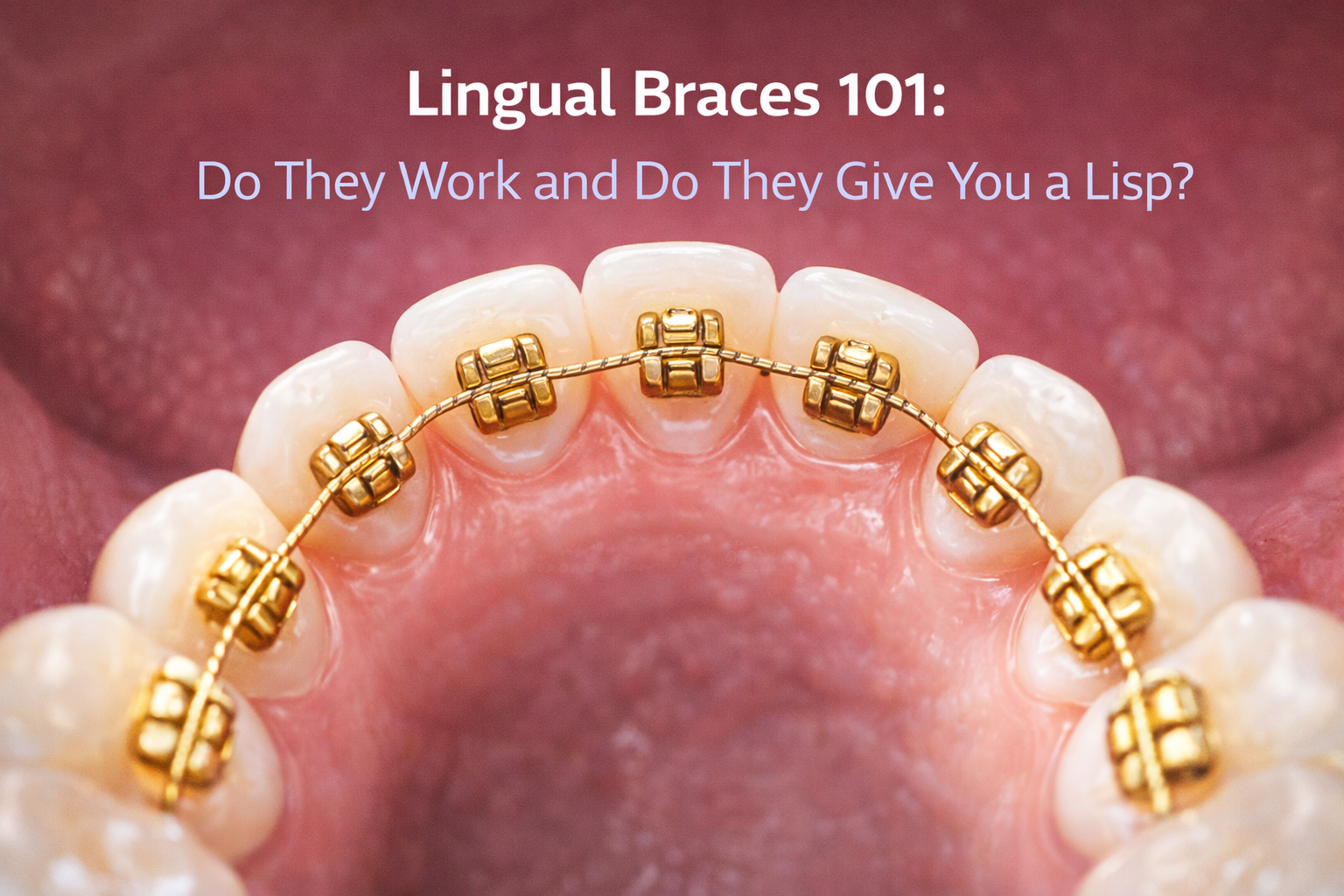
“Lingual” refers to the tongue side of the mouth. Unlike standard braces bonded to the front, these are bonded to the back. Because the back of your teeth has a unique, irregular shape (unlike the flat front), you cannot use “stock” brackets.
-
100% Customized: Each bracket is custom-cast (often using gold alloys) to fit the exact topography of your individual tooth.
-
Robot-Bent Wires: The wires are bent by robots based on a digital scan to ensure precise movement in a tight space.
Do Lingual Braces Work?
Yes, absolutely. In fact, for certain movements, they are superior to Invisalign.
Because they are fixed appliances, they have continuous 3-dimensional control over the tooth root. They are excellent for:
- Closing extraction spaces (where Invisalign struggles).
- Rotating rounded teeth (like canines and premolars).
- Deep bite correction (opening the bite).
Compare efficacy with other types in our Metal vs Invisalign Showdown.
The “Lisp” Reality Check
Do they give you a lisp?
Short answer: YES.
Your tongue touches the back of your upper front teeth to make “S”, “T”, “D”, and “Th” sounds. With brackets in the way, your tongue gets confused.
The Timeline of Speech Recovery:
- Week 1: Significant lisp. Speech may sound “slushy.” Tongue will be sore.
- Week 2: Tongue adapts. Lisp is noticeable only when tired or speaking fast.
- Week 3-4: Speech returns to 95-100% normal.
Survival Tip: Read the “Rainbow Passage” aloud 5 times a day. It forces your tongue to relearn positions quickly. Also, stock up on Orthodontic Wax—your tongue will need it!
Do Lingual Braces Cost More?
Yes, they are the “Rolls Royce” of orthodontics. You can expect to pay 30-50% more than traditional braces.
| Type | Cost Range | Why? |
|---|---|---|
| Traditional Metal | $3,000 – $7,000 | Mass-produced parts. |
| Lingual (Incognito) | $8,000 – $13,000+ | Custom Gold Casting + Difficult Labor. |
See our Ultimate Cost Breakdown for details on payment plans and insurance limits for lingual appliances.
Pros & Cons Summary
The Good
- 100% Invisible: Only you know they are there.
- Zero Compliance: Unlike Invisalign, you can’t “forget” to wear them.
- No Stain Risk: If you drink coffee and stain the glue, it’s behind your teeth!
The Bad
- Tongue Irritation: High initial discomfort.
- Speech Lisp: Guaranteed for 2-3 weeks.
- Cleaning Nightmare: You cannot see to floss. Water Flosser is mandatory.
Is It Worth The Struggle?
If your career depends on speaking (teacher, actor, sales) and you cannot be disciplined with Invisalign trays, Lingual braces are a game-changer. The 2 weeks of lisping are a small price for 18 months of invisible treatment.
Compare All Options NowExplore Options
True Invisibility
Only Lingual braces are truly unnoticeable.