
Orthodontics: How Digital Scans Predict Your Smile Better Than Wax
Quick Summary
Modern orthodontics has abandoned messy putty molds. Discover how 3D intraoral scanners and Artificial Intelligence are making treatment faster, more accurate, and entirely gag-free.
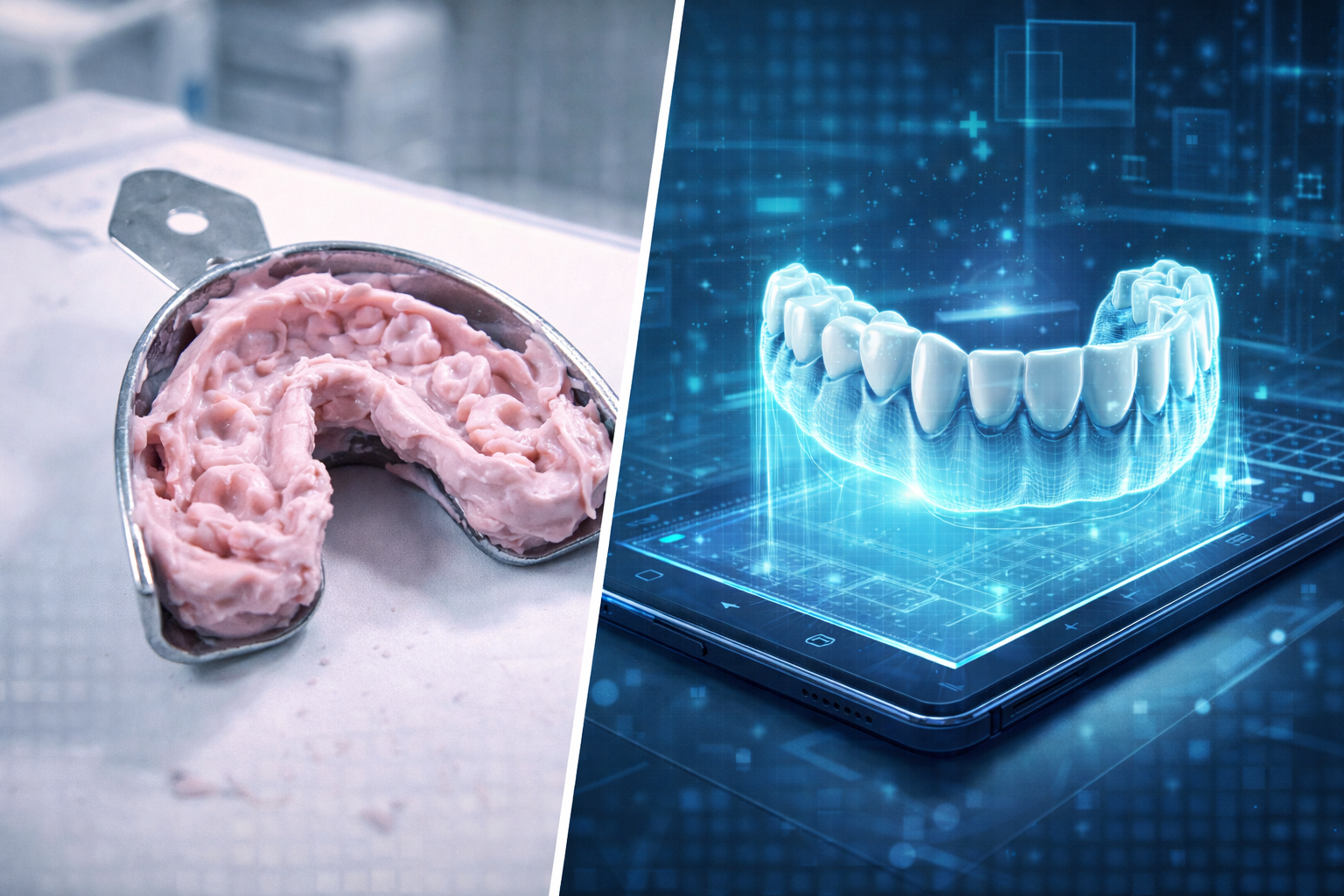
If you’ve ever had traditional dental work, you likely remember the dreaded PVS (Polyvinyl Siloxane) impressions. The gooey pink paste, the massive metal tray, and trying desperately not to gag for 5 long minutes.
In 2026, those days are officially over. Artificial Intelligence and 3D intraoral scanners have completely revolutionized how we plan, predict, and perfect your orthodontic treatment.
The Problem with Analog Putty
Beyond the severe physical discomfort, traditional analog impressions are prone to human error. Saliva, tiny air bubbles, or removing the tray a second too early can distort the physical mold.
When the lab creates appliances based on a distorted mold, the fit is poor. This leads to emergency visits and is one of the hidden reasons why your treatment speed might be delayed.
Enter the 3D Intraoral Scanner
Today, leading clinics use high-definition wand cameras (like the iTero or Trios). The doctor glides a small wand over your teeth, capturing thousands of microscopic images per second to create a flawless, full-color 3D replica of your mouth instantly.
Traditional Putty
- • Triggers severe gag reflex
- • Takes 5-10 messy minutes
- • Prone to shrinkage and distortion
- • Takes weeks to mail to the lab
Digital 3D Scans
- • Zero gagging, breathe normally
- • Completed in 60-90 seconds
- • 100% microscopically accurate
- • Sent instantly via cloud to AI labs
How AI Predicts Your Future Smile
Capturing the 3D model is only step one. The real magic happens when that digital model is fed into Artificial Intelligence software.
- Root Mapping: AI doesn’t just look at the visible crown. It predicts how hidden roots will move through your jawbone, ensuring safe biological movements.
- Collision Detection: The algorithm calculates millions of pathways to ensure teeth don’t crash into each other while rotating.
- Instant Smile Simulator: Within minutes, the AI generates a predictive time-lapse video. You see your final smile before you even sign up for a payment plan.
Clinical Case Study: Analog vs. Digital
Comparing treatment efficiency for two patients with identical severe anterior crowding.
Patient A (Manual Analog):
Brackets placed visually based on analog molds. At 12 months, teeth stopped tracking. Required mid-course correction. Total time: 26 Months.
Patient B (AI Digital):
Scanned with 3D iTero. AI mapped bone limits and pre-calculated collision points. Custom robotic-bent wires ordered. Total time: 16 Months.
The Verdict
If an orthodontic clinic tries to pull out the pink putty in 2026, you might want to ask if they offer digital scans. AI and 3D technology aren’t just fancy gadgets—they are essential tools for a faster, less painful, and more precise perfect smile.
Ready to choose your treatment?
Now that you understand the technology, see how different braces types compare head-to-head.
Compare Invisalign vs Metal BracesRelated Articles
Are Scans Safe?
Yes! 3D intraoral scanners emit ZERO radiation. They simply take thousands of rapid digital photographs.