
Overbite Treatment: Braces vs. Aligners (A Clinical Guide)
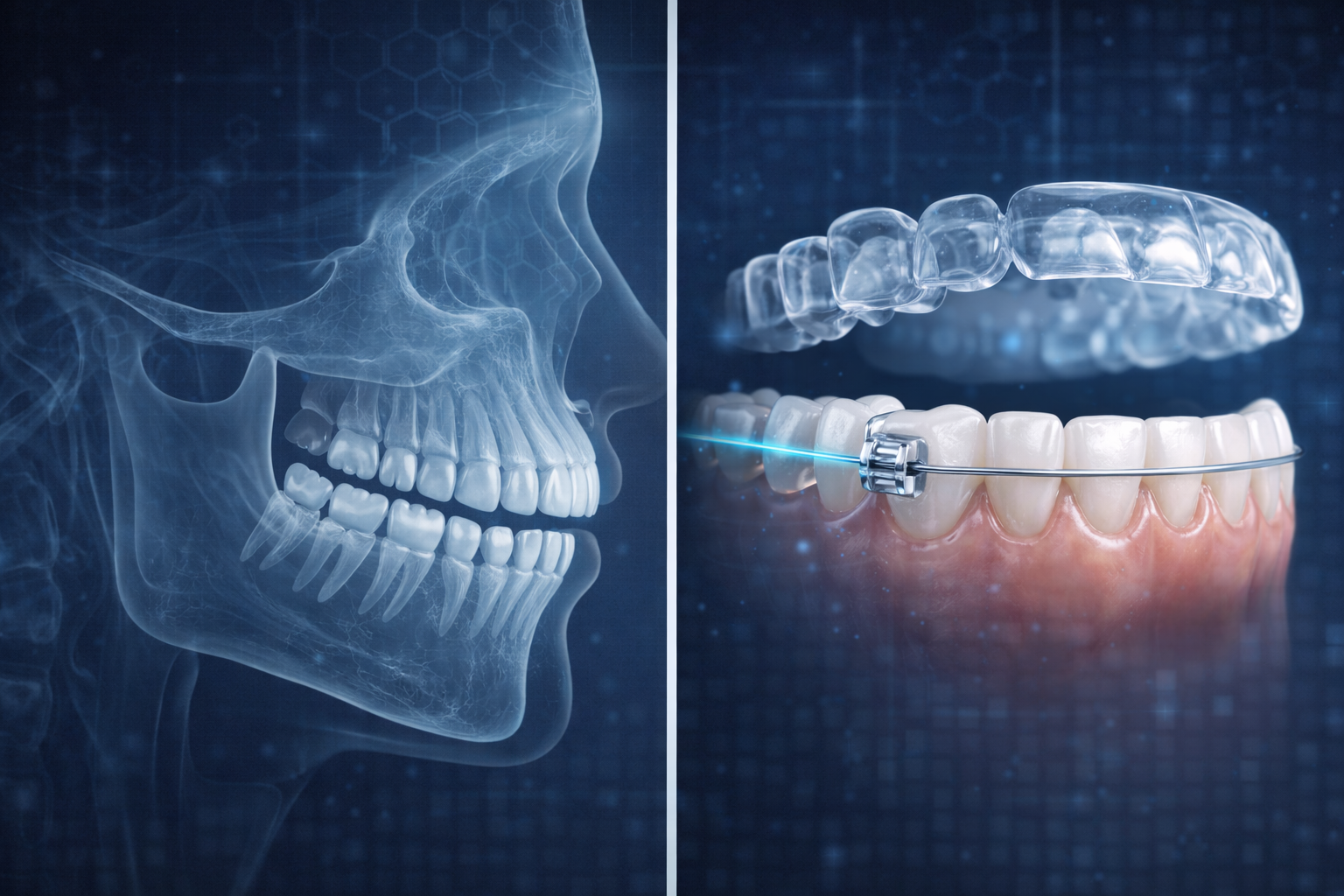
Not all overbites are merely cosmetic issues. When a patient presents with a “deep bite,” we are often looking at an excessive vertical overlap that severely impacts jaw function, causes premature enamel wear, and increases the risk of TMJ disorders.
The critical clinical question isn’t just “How do we fix it?” but rather, “Which biomechanical tool is actually capable of fixing it safely?”
The choice between traditional braces and clear aligners depends heavily on the severity of the vertical overlap and whether the root cause is dental (teeth tilting) or skeletal (jawbone structure).
What Is an Overbite? (The Clinical Definition)
In orthodontics, an “overbite” refers strictly to the vertical overlap of the upper front teeth over the lower front teeth.
- Normal Overbite: According to the American Association of Orthodontists (AAO), a healthy bite has about 2 to 3 millimeters of vertical overlap.
- Deep Overbite: An excessive overlap where the top teeth cover a significant portion (or all) of the bottom teeth. In extreme cases, the lower teeth bite directly into the roof of the mouth (palatal impingement).
Furthermore, specialists must diagnose whether the overbite is Dental (the teeth are simply angled incorrectly) or Skeletal (the upper jaw bone is significantly longer or positioned further forward than the lower jaw).
How Overbite Severity Is Classified
The severity directly dictates our treatment strategy and appliance choice:
Mild Overbite
≤ 4 mm overlap
Often purely cosmetic. Easily manageable with either braces or clear aligners without complex mechanics.
Moderate Overbite
4 – 6 mm overlap
Requires specific intrusion mechanics. Clear aligners need heavy attachments; braces handle this routinely.
Severe Overbite
> 6 mm (Deep Bite)
Lower teeth may damage upper gums. Requires heavy 3D vertical control, heavily favoring fixed braces or surgery.
The Biomechanics: How Do We Actually Fix It?
As we explored in our Clinical Complexity Matrix, moving teeth vertically (intrusion/extrusion) is the hardest movement in orthodontics. Here is how both systems handle it:
Overbite Correction With Braces
Braces offer superior vertical control. To fix a deep bite, an orthodontist uses:
- Intrusion Mechanics: Pushing the front teeth up into the jawbone.
- Reverse Curve Archwires (Curve of Spee): Special wires that actively level the bite 24/7.
- Bite Turbos / Ramps: Small blocks placed behind the upper front teeth to prop the bite open, allowing the back teeth to erupt (extrude) and level the jaw.
- Class II Elastics: Heavy rubber bands that pull the lower jaw forward.
Overbite Correction With Clear Aligners
Aligners push teeth using programmed plastic deflection. To fix an overbite, they require:
- Programmed Intrusion: The trays are designed slightly shorter than the teeth to push them up.
- Optimized Attachments: Geometric composite bumps glued to the premolars to anchor the plastic tray so it doesn’t pop off when pushing the front teeth up.
- Precision Cuts: Slits in the plastic to attach elastic bands.
- Limitation: Plastic flexes under heavy vertical load, making severe intrusion less predictable than rigid metal wires.
Clinical Comparison: Braces vs. Aligners for Overbites
| Clinical Factor | Traditional Braces | Clear Aligners (e.g., Invisalign) |
|---|---|---|
| Mild Overbite | Excellent | Excellent |
| Moderate Overbite | Excellent | Good (Needs Attachments) |
| Severe Deep Bite | Highly Predictable | Limited / Unpredictable |
| Skeletal Cases | Often Necessary | Rarely Sufficient |
| Patient Compliance Dependence | Low (Works 24/7) | Extremely High |
When Do Aligners Work Well for Overbites?
Clear aligners are highly effective if the case parameters are right. They are a fantastic choice for:
- Mild to Moderate Deep Bites: Where vertical correction requirements are minimal.
- Adult Aesthetic Priority: When invisible treatment is non-negotiable for professional reasons.
- Highly Compliant Patients: Fixing an overbite requires strict 22-hour/day tray wear and diligent elastic use.
When Are Braces Clinically Preferred?
Your orthodontist will likely strongly recommend traditional metal or ceramic braces if you present with:
- Severe Vertical Overlap: Where the lower teeth hit the palatal gums.
- Complex Class II Malocclusions: Severe “buck teeth” requiring massive root torque to pull them backward through the bone safely.
- Teen Patients: Where growth modification (using appliances like a Herbst) is needed alongside tooth movement.
Timelines and Cost Expectations
Fixing an overbite generally adds time and cost to standard treatment because correcting a bite (function) takes much longer than simply straightening crooked front teeth (aesthetics).
Expect treatment timelines to range from 6–12 months for mild cases, 12–18 months for moderate cases, and up to 18–24+ months for severe or skeletal deep bites.
As detailed in our Comprehensive Cost Guide, severe overbites treated with aligners often require multiple “Refinement” phases (new scans and extra trays), which can sometimes increase the total cost compared to standard braces.
The Bottom Line
An overbite is a complex biomechanical issue, not just a crooked tooth.
While aligners are an incredible tool for mild to moderate cases, severe deep bites require the rigid 3D control of traditional braces. Trust your orthodontist’s diagnosis over brand marketing.
Read the Full Clinical Complexity GuideMedical Disclaimer: This article is intended for educational purposes only to explain orthodontic biomechanics. Overbite severity and treatment suitability must be determined through comprehensive diagnostic records (X-rays, 3D scans) and an in-person clinical exam by a licensed, board-certified orthodontist. Do not attempt to self-diagnose skeletal vs. dental malocclusions.
Related Clinical Guides
Untreated Overbites
Ignoring a severe deep bite can lead to premature enamel wear, gum recession, and chronic TMJ (jaw joint) pain as you age.