
Underbite Correction Options: Braces, Aligners, or Surgery?
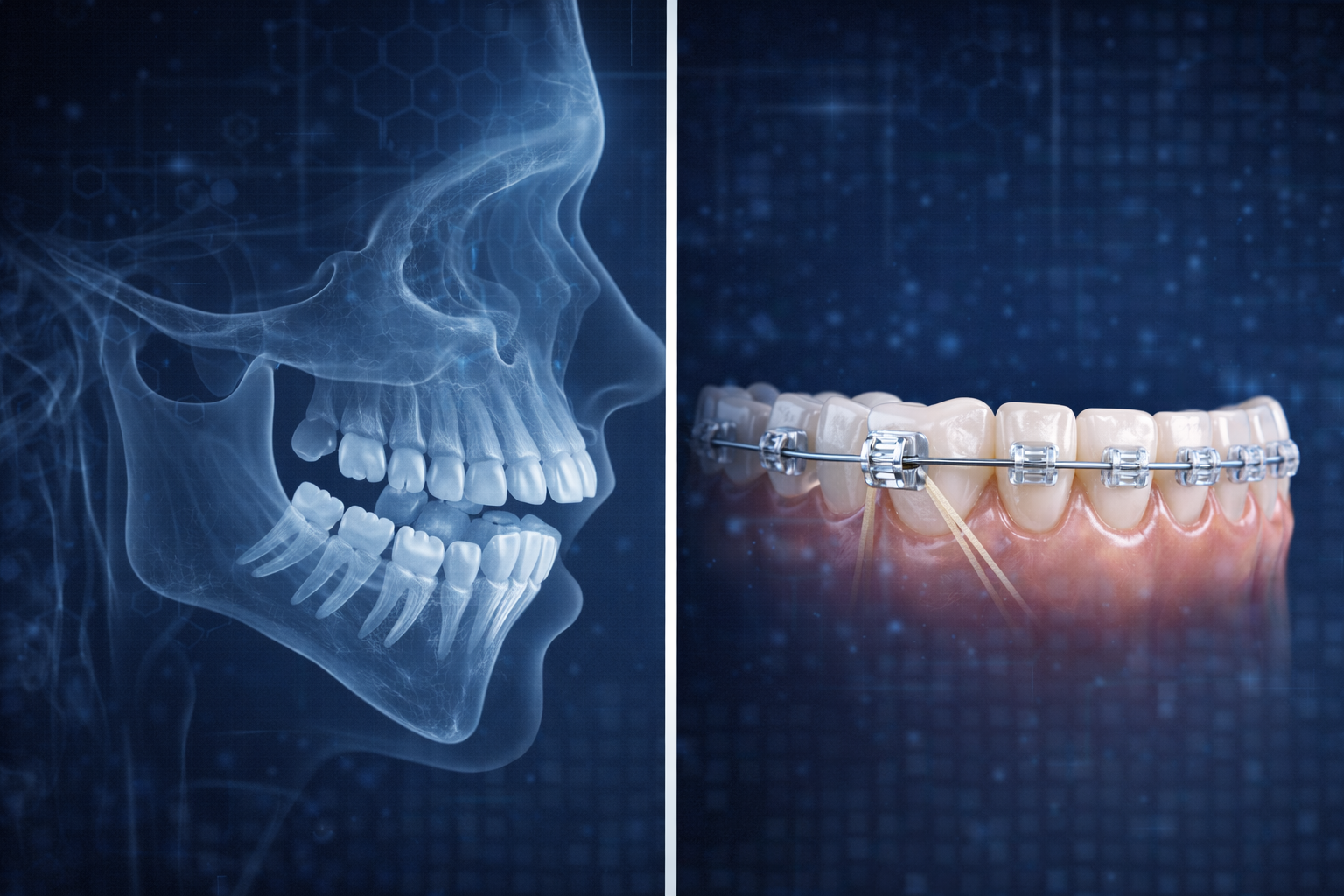
An underbite is not just a cosmetic misalignment of the front teeth. In moderate to severe cases, it reflects a foundational skeletal discrepancy between the upper and lower jawbones.
“Before asking ‘Which braces should I get?’, a clinical diagnosis must determine whether your underbite is purely Dental (involving just the teeth) or Skeletal (a true Class III Malocclusion).”
The distinction between moving a tooth and compensating for an overgrown jawbone changes everything about your treatment timeline, cost, and appliance choice.
What Is an Underbite?
Clinically known as a Class III Malocclusion or a “reverse overjet,” an underbite occurs when the lower anterior (front) teeth protrude completely in front of the upper anterior teeth when the jaw is closed.
According to the American Association of Orthodontists (AAO), while overbites are relatively common, true severe underbites affect a much smaller percentage of the population and are highly hereditary.
Types of Underbite: Dental vs. Skeletal
Understanding the origin of your underbite is the single most critical factor in choosing a treatment option.
Dental Underbite
The upper and lower jawbones are relatively proportional and aligned properly. However, the teeth themselves are angled incorrectly. The upper teeth may be tilted inward, or the lower teeth tilted outward, creating the reverse overlap.
Easier to treat orthodonticallySkeletal Underbite
A structural bone issue. This is usually caused by Mandibular Prognathism (the lower jaw bone grew too long/far forward) or Maxillary Deficiency (the upper jaw failed to grow forward enough).
Highly complex, may require surgerySeverity Classification & The Age Factor
- Mild: ≤ 2 mm reverse overjet. Often purely dental.
- Moderate: 3 – 4 mm. Requires complex biomechanics.
- Severe: > 4 mm. Facial jaw discrepancy is clearly visible from a profile view.
Treatment Options Overview
Depending on the clinical complexity outlined above, your orthodontist will utilize one of the following tools:
1. Traditional Braces (The “Camouflage” Method)
For mild to moderate skeletal underbites in adults, orthodontists use braces to perform “Camouflage Treatment.” They cannot shrink your jawbone, but they can angle the teeth drastically to hide the skeletal issue.
- Archwire Control: Rigid wires torque the upper roots backward while flaring the crowns forward.
- Class III Elastics: Heavy rubber bands attached from the upper back molars to the lower front teeth to pull the lower teeth back and shift the bite.
2. Can Clear Aligners Fix an Underbite?
Yes, but only under specific clinical conditions. As noted in our clinical complexity guide, clear aligners (like Invisalign) work well for mild dental underbites.
However, they are severely limited in skeletal cases. To work at all on an underbite, aligners will require heavy composite “attachments” glued to your teeth and precision cuts in the plastic to hook up Class III elastics. Furthermore, success is 100% dependent on strict 22-hour-a-day patient compliance.
3. When Orthognathic Surgery Is Required
If an adult patient presents with a severe Class III skeletal underbite, braces alone will fail. If the doctor tries to tip the teeth too far to compensate for a massive jaw discrepancy, the roots of the teeth will literally be pushed out of the bone.
In these cases, a combined Ortho-Surgical Approach is required. You will wear braces for a year to align the teeth over their respective bones. Then, an oral maxillofacial surgeon will perform Orthognathic Surgery to physically cut and slide the lower jaw back (or the upper jaw forward). You finish with 6 more months of braces to perfect the bite.
Treatment Timeline & Efficacy Comparison
| Underbite Severity | Braces Timeline | Aligners Timeline | Surgery Required? |
|---|---|---|---|
| Mild (Dental) | 12–18 months | 12–18 months | Not Needed |
| Moderate (Mild Skeletal) | 18–24 months | Variable / Unpredictable | Rare |
| Severe (Skeletal Class III) | Limited (Camouflage only) | Not Sufficient | Often Required |
Cost Considerations
Because treating an underbite takes longer and involves complex mechanics (heavy elastics, custom wires), it often sits at the higher end of the average braces cost spectrum.
If orthognathic surgery is required, the cost increases significantly (often adding $20,000 – $40,000 for the surgical hospital fee alone). However, because severe skeletal underbites impair breathing, chewing, and speaking, jaw surgery is often deemed “medically necessary” and may be covered by major medical insurance or Medicaid under strict HLD index scoring.
Risks of Leaving an Underbite Untreated
Deciding not to treat a severe underbite is risky. Over time, the structural imbalance causes:
- TMJ Strain: Chronic jaw joint pain and popping.
- Pathological Tooth Wear: The enamel on the front teeth grinds away completely because they hit edge-to-edge.
- Chewing Dysfunction: Inability to properly bite into foods like apples or sandwiches.
- Aesthetic Impact: A prominent lower jaw (“bulldog” appearance) can cause significant psychological distress.
The Clinical Reality
An underbite is one of the most mechanically demanding issues in orthodontics.
While mild cases can be masked with braces or aligners, severe skeletal discrepancies require honest conversations about surgical intervention to prevent long-term joint and enamel destruction.
Compare This With Overbite TreatmentsMedical Disclaimer: This article is an educational resource explaining the biomechanical and surgical aspects of Class III malocclusions. It does not replace a clinical diagnosis. Determining whether an underbite is dental or skeletal requires lateral cephalometric X-rays and physical evaluation by a board-certified orthodontist and/or oral maxillofacial surgeon.
Clinical Deep Dives
Parents Take Note
Underbites are best treated before age 10. Early intervention with a facemask can often prevent the need for adult jaw surgery.