
Braces vs. Aligners: A Decision Matrix Based on Clinical Complexity
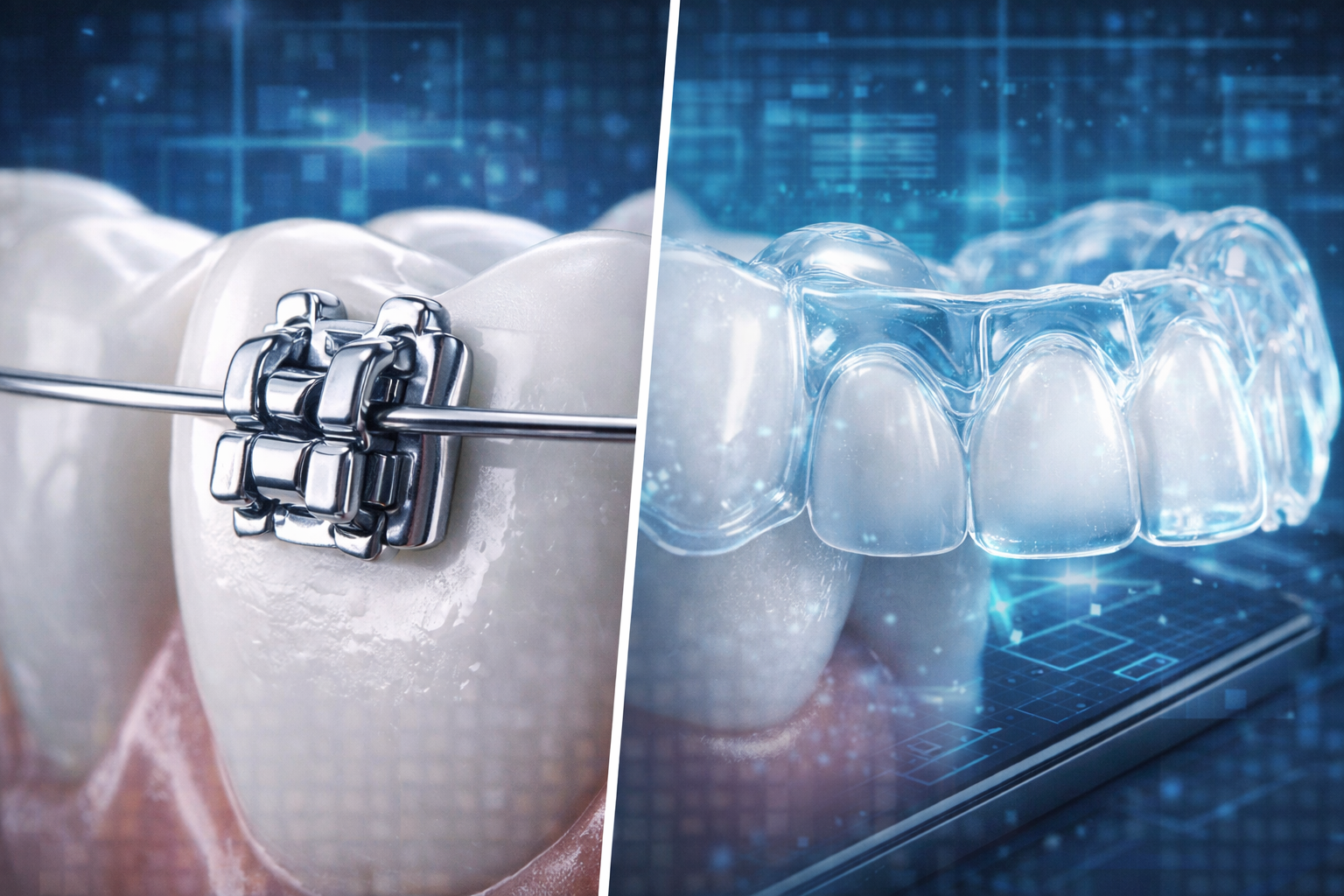
If you search the internet for “Braces vs. Aligners,” 99% of the articles will ask you two questions: “Which is cheaper?” and “Which looks better?” These are the wrong questions.
“Orthodontic treatment choice should be based on biomechanical complexity, not marketing preference.”
The real question you must ask your orthodontist is: “Is my clinical case actually suitable for clear aligners?” While plastic trays are fantastic, they have distinct biological and mechanical limits. Today, we step away from the marketing hype and look at the raw clinical data.
What Determines Clinical Complexity?
Orthodontists don’t just look at crooked teeth; they measure the geometry of your bite. According to standards utilized by the American Association of Orthodontists (AAO), case complexity is determined by:
- Severity of crowding: Measured in millimeters (e.g., >8mm is severe).
- Vertical issues: Severe Overbites (Deep bite) or Open bites.
- Tooth Rotations: Canines or premolars rotated more than 20 degrees.
- Skeletal discrepancies: Issues rooted in the jawbone length, not just the teeth.
- Impacted teeth: Teeth trapped under the gums requiring forced eruption.
The Biomechanics: Brackets vs. Plastic Trays
To understand why certain cases fail with aligners, we must look at physics.
Traditional Braces
Because brackets are glued directly to the tooth and connected by a rigid wire, they provide true 3D control. They excel at “torque expression”—meaning they can grab a tooth and physically drag its hidden root through the jawbone predictably.
Clear Aligners
Aligners push teeth. They have limited torque control because plastic flexes. To grip a round tooth, they depend heavily on “attachments” (composite bumps glued to your teeth). Even then, complex root movements are mathematically less predictable.
*Clinical Example: A severe Class II malocclusion with a vertical component (deep bite) often overwhelms the pushing capacity of plastic trays, requiring the heavy elastic force systems unique to fixed braces.
The Clinical Decision Matrix
Use this matrix as a baseline reference before consulting your doctor.
| Clinical Case Type | Metal/Ceramic Braces | Clear Aligners | General Recommendation |
|---|---|---|---|
| Mild crowding (< 4mm) | Excellent | Excellent | Either (Patient Preference) |
| Moderate crowding (4–8mm) | Excellent | Good | Case-dependent |
| Severe crowding (> 8mm) | Excellent | Limited | Braces Preferred |
| Deep Bite / Overbite | Excellent | Moderate | Often Braces |
| Skeletal Class III (Underbite) | Necessary | Rarely Sufficient | Braces + Surgical Plan |
Real-World Limitations of Aligners
While AI digital scans create beautiful 3D simulations of aligner results, reality doesn’t always match the computer. Limitations include:
- Predictability vs Simulation: Teeth are anchored in living bone, not pixels. A tooth may simply refuse to rotate with a plastic tray.
- Refinement Stages: Most aligner patients need “refinements”—scanning the teeth again and ordering more trays because the teeth stopped “tracking” the original plan.
- Compliance Failures: If you don’t wear them 22 hours a day, they fail. Period.
- Attachments Visibility: To move difficult teeth, doctors glue many attachments to your front teeth, making them far less “invisible” than advertised.
Cost vs. Clinical Outcome
Choosing aligners for a severe case to avoid metal can backfire financially. If the aligners fail to achieve the complex movements required, you face Retreatment Cost. You may end up paying for aligners, only to switch to braces mid-treatment to finish the job. Understanding true treatment costs involves assessing predictability, not just the initial quote.
When Aligners Are Truly Ideal
We are not attacking aligners; they are brilliant tools when used correctly. They are the absolute best choice for:
- Mild Relapse Cases: You wore braces as a teen but lost your retainer.
- Adult Aesthetic Priority: Mild to moderate crowding where aesthetics matter more than perfect biomechanical speed.
- Busy Professionals: Fewer emergency visits for broken wires.
The Final Word
Orthodontics is controlled force application, not a cosmetic accessory choice.
If your doctor recommends braces over aligners, it is likely because your roots and jawbone require 3D control that plastic cannot provide. Trust the biomechanics.
Read Our Ultimate Metal vs Invisalign ShowdownMedical Disclaimer: This article serves as an educational resource to explain orthodontic biomechanics. It does not constitute a medical diagnosis. Case complexity and treatment suitability must be determined by an in-person clinical exam and radiographic analysis by a licensed, board-certified orthodontist.
Related Tech & Guides
The “DIY” Danger
Never attempt complex root movements with mail-order aligner companies. Direct doctor supervision is crucial.